
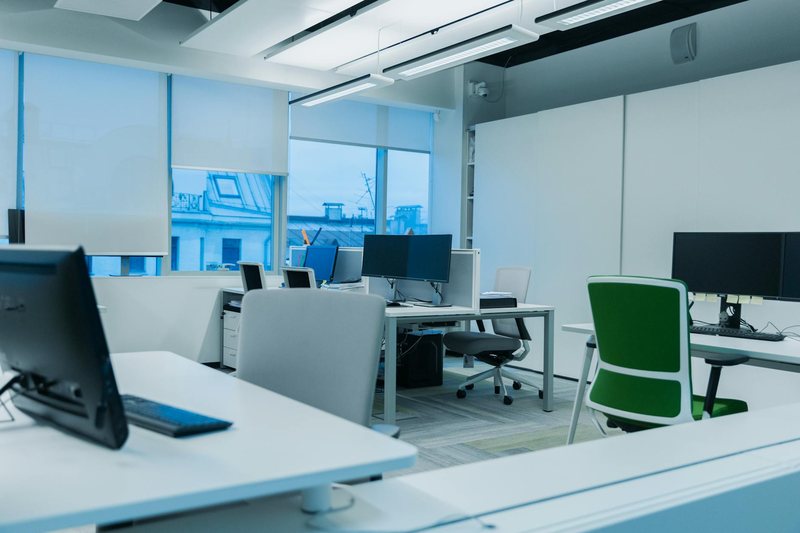
Coworking and serviced offices need two cleaning shifts, not one: a daytime porter who keeps shared kitchens, breakout areas and washrooms presentable through peak occupancy, plus a full evening clean of desks, meeting rooms and floors. In a members’ business, visible cleanliness is a retention tool - so OptusGlean builds both into a single fixed monthly contract.
What does cleaning a coworking or serviced office involve?
Flexible workspaces churn constantly - hot desks change hands hourly, meeting rooms turn over between bookings, and shared kitchens take the strain all day. A coworking clean therefore spans high-touch sanitising of desks, door handles and kitchen surfaces, replenishment of washroom and kitchen consumables, breakout and phone-booth resets, glass and reception presentation, and a full evening floor and washroom clean. We follow the BICSc four-colour coding scheme (red for washrooms, blue for general areas, green for kitchens, yellow for any clinical area) to prevent cross-contamination.
Why do flexible workspaces need daytime porters as well as an evening clean?
Members judge an operator on what they see at 11am, not what the night team did at 9pm. A daytime porter keeps kitchens, washrooms and breakout zones continuously presentable during peak occupancy, deals with spills and overflowing bins on the spot, and frees your community team from cleaning duties. The evening shift then delivers the deep desk, meeting-room and floor clean once the building empties. One contract covers both.
How is hot-desking managed for hygiene?
Shared desks are the hygiene weak point of any coworking model. We sanitise desk surfaces, monitors, keyboards and chair arms as part of the daily specification, prioritise high-touch points, and can add midday touch-point rounds where occupancy is high. Meeting rooms are reset and wiped between the working day and the evening clean so the next member walks into a clean space.
What does coworking cleaning cost?
Independent UK market guides put commercial office cleaning at roughly £16-£30 per cleaner-hour, or around £1.50-£4 per square metre per clean, with monthly office contracts ranging from £300-£800 for small sites up to £2,000-£5,000+ for large multi-floor spaces (sources: Bark, MyJobQuote, The Clean Space). We don’t charge by the hour.
OptusGlean prices every contract as a single fixed monthly fee paid by Direct Debit - never an hourly rate that drifts. The fee is built from the specification agreed at your free site survey, and it already accounts for the wage floor (National Living Wage £12.71/hr from April 2026, or the real Living Wage of £13.45 UK / £14.80 London where a contract requires it), employer’s NI, holiday pay, supervision, consumables, insurance and management. VAT is added at the standard 20%.
How OptusGlean staffs and vets a coworking contract
Every OptusGlean operative is directly employed on PAYE and vetted before their first shift. We DBS-check operatives in England and Wales, and apply the equivalent PVG (Disclosure Scotland) and AccessNI checks in Scotland and Northern Ireland. Where a site involves regulated activity with children or vulnerable adults, an Enhanced DBS (currently £49.50, gov.uk) is used. We never sub-contract to unvetted labour. You get a named account manager, a documented specification, and one fixed monthly price across every site in your estate - useful for operators running multiple buildings in different cities.